
ANNA ODESSA LINZER

Anna Odessa Linzer has always lived along the Salish Sea. Her deep connection with the Pacific Northwest is reflected in both her poems and her fiction. Her novel Ghost Dancing (Picador/St. Martin’s Press) received an American Book Award in 1999. Her novels Blind Virgil, Dancing on Water, and A River Story were produced as the handbound, limited-edition Home Waters by fine-arts publisher Marquand Books. A River Story was adapted and performed as a two-person play, and her poems have been featured in gallery and museum installations as well as on wine bottles.
As a bookbinder and designer, Linzer received a Pacific Northwest Booksellers Award for Excellence in 1975. One of her sculptural handbound books received an award at the Bellevue Arts Museum Arts Fair in 1976. Her nonfiction work received a Terry McAdams Award in 2000. She has been a copyeditor for PARIS, LA; a fiction editor of Raven Chronicles; and a chair of the PEN West Literary Awards. She has often worked on environmental protection and restoration issues, including founding one of the first land trusts in Washington State.


NEWEST RELEASE!
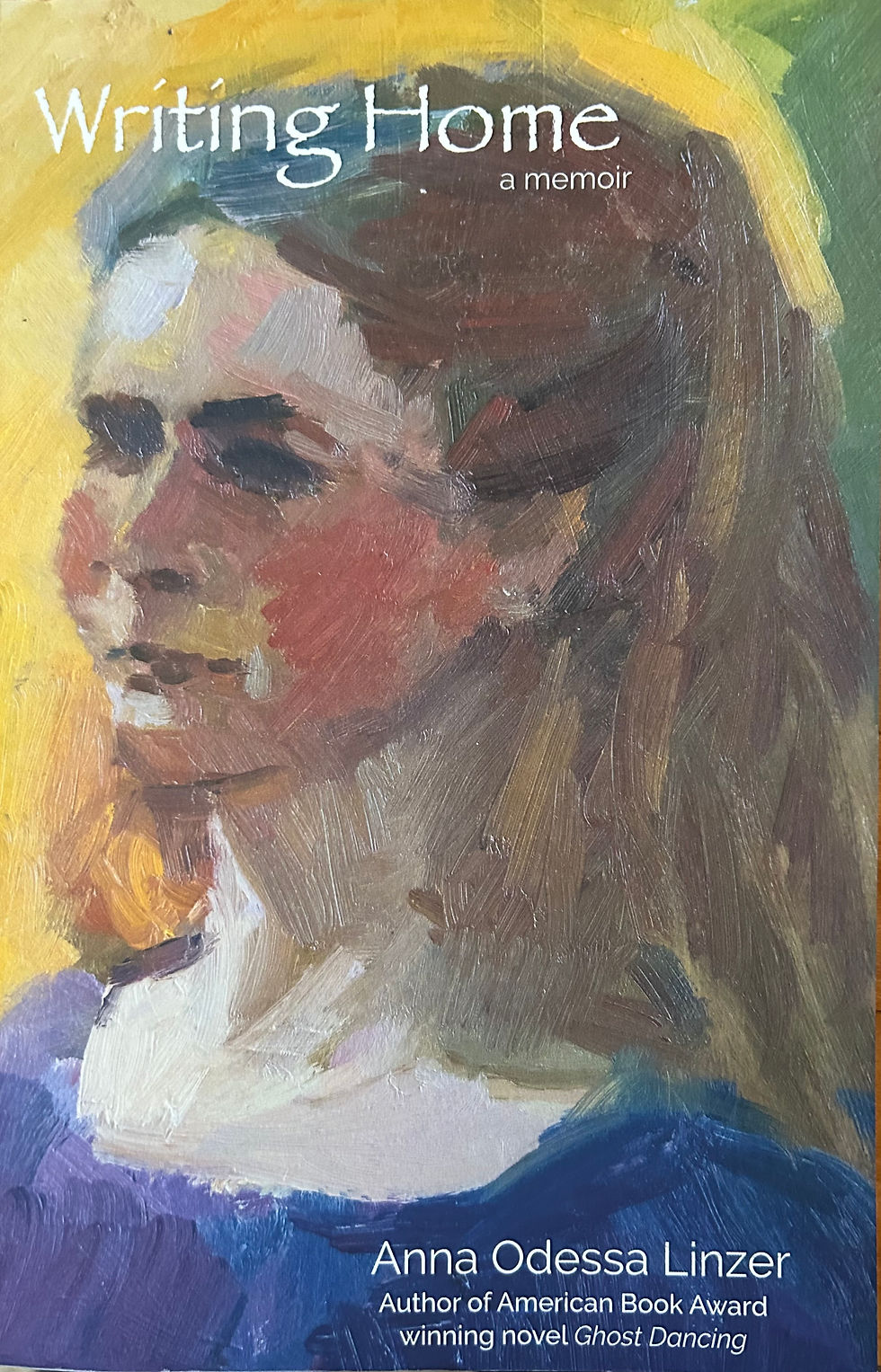
Writing Home
WRITING HOME
Writing Home is a mediation on place: place, architecture, family, and wilderness on an isolated bay on the Salish Sea. Anna gives us her heart’s measure of pain and also the hard-earned pleasures of creating life in the aftermath of betrayal. She finds herself in the Treehouse, built in an old forest teeming with life on a deep, isolated bay in the Salish Sea. In this rich and lyric memoir, Linzer slowly, and with a poet’s eye for detail, charts her journey to discover and reveal the essence of home.

“ . . . just as two black brushstrokes across the cream of handmade paper evoke a mountain in the moonlight, they also join other nights, other mountains, other moonlight. These brushstrokes join to other days. Other words. Sometimes the simple black brushstrokes are enough. All we need.
The Treehouse became a gift of a dream. Time folded in on itself, expanded, and sometimes fell away altogether. Leaving us there, perfectly. We might have been there lifetimes, years, seconds. Who is to know.
Maybe we are still there.”

OTHER ANNA ODESSA LINZER BOOKS


Finnriver Cider Garden

Sorry we missed you for the reading & conversation with two Empty Bowl poets who explore their deep connection to the land in their work. Anna Linzer joins us from Dabob Bay, and Mistee St. Clair joins us from her home in Alaska.
Both authors read from recently published works. Anna Odessa Linzer read from her memoir, Writing Home, and Mistee St. Clair read from her debut poetry collection, Reconciliations.
We hope to see you at the next reading!
Reading and Art Installation Peter Miller Architecture and Design Books -Writing Home
American Book Award winner Anna Odessa Linzer read from her memoir. Works by her sons, the artists Oscar Tuazon and Elias Hansen, were featured at the Peter Miller Gallery from May through the end of June.
In this beautiful memoir, Anna Linzer writes about life and her life in a remote structure on the forested shore of Dabob Bay. Built in 1981, it was my first house. I have always loved it, and I am honored that Anna, its second owner, does too.
—Tom Bosworth, professor emeritus of architecture, University of Washington
A review from Anna Linzer's reading at Imprint Bookshop on the launch of her memoir, Writing Home.


Dear friends,
This letter has been a long time coming — not for lack of things to say, but because the world has been moving so fast that I couldn't find the stillness to say them. You know what I mean. The news cycle has been relentless in a way that makes it genuinely hard to know where to put your attention, or your grief, or your outrage. And yet, right in the middle of all of that — in the very weeks when closing down felt like the only reasonable response — something in me cracked open instead.
It came, as it often does here, through books and the people who write them, and through the particular kind of community that forms when people who love the written word choose to show up together in the same room. Two author events, barely a week apart. Two women whose work insists on paying attention — both of them doing, from their own corners of the world, exactly what this moment seems to require.
The first was April 2nd, when we had the honor of hosting Anna Odessa Linzer for the launch of her new memoir, Writing Home. This event carried particular weight for me because of the family connections between us — Annie's son Eli and my younger brother Joey grew up together, best friends since their time at Suquamish Elementary School, and longtime collaborators in art and mischiefmaking. Tragically, Joey passed away twelve years ago this May.
When Annie told me he had a place in this book, I knew it was coming. What I wasn't prepared for was seeing his name in print — not just once, but woven throughout the pages. There is something about seeing your deceased younger brother's name on a page — held there with tenderness by someone who loved him too — that both breaks something within you open and, inevitably, sets another wave of grief in motion.
Writing Home is a vulnerable book — an honest account of loss and betrayal and the grief that doesn't resolve so much as it changes shape. I read it on my morning dog walks throughout early March, book in one hand, leash in the other, and it came to me the way birdsong does at the turn of winter into spring: unexpected, clarifying, exactly what you didn't know you needed. Once inside it, the experience is something else — moss-laden, slow, patient, attentive to the exact texture of the ground beneath your feet in these haunted places we call home. Annie writes:
"I know that there is no past tense of grief. Only this dance through the seasons."
This is precisely where I have been living — in that dance — leading up to that event and in the weeks that have followed. Looking at what remains hidden within the permafrost of my own soul, the healing that is being asked of me, that I asked of myself when I made the choice to return home here to this haunted landscape and rocky shores of the Salish Sea. Reading Annie’s memoir and then hearing her read from it in person brought tears to my eyes and to many who gathered with us that night. Annie is the author of nine books — most recently the poetry collection Season Unleashed (Empty Bowl Press) — and her novel Ghost Dancing received an American Book Award. She founded the first land trust in Washington State, and swims year-round in Dabob Bay. She is, in other words, someone who means it when she writes about belonging to a place and I cannot recommend Writing Home more highly.
Then, barely a week later, I had the distinct privilege of welcoming one of my greatest literary mentors, Terry Tempest Williams, to Port Townsend.

KPTZ 91.9 FM Dramatic Reading Anna Odessa Linzer -A River Story

Anna Linzer's novel, A River Story, was originally adapted by Elizabeth Huddle and Anna as a two-person dramatic reading and performed in Seattle, Edison, and Port Townsend, WA. Phil Andrus of KPTZ adapted a portion for a radio reading, performed by the poet Bill Mawhinney and the Sunfield School student Willow Baker on December 14, 2024.

BIMA Curated Conversations Recap: Anna Odessa Linzer - Season Unleashed
"Understand that heretofore my closest brush with poetry has been the lyrics of Bob Dylan, John Lennon and Roger Waters, always accompanied by rock and roll riffs...this is my first real immersion into a purer manifestation; poetry unsupported by instrumentation, unconcerned with rhyme but rife with rhythm form, with profound and personal broadsides that tell a complete story."
STEVE IMESON, Musician, Ski Instructor
FULL RAVEN CHRONICLES REVIEW
OF SEASON UNLEASHED
Slipping into a side path, off the dirt road, my feet touch the soft / cushion of deep moss, my heart touches silence and beauty, / a world that has been there—and not there—all these months.
—Anna Odessa Linzer, “Off Trail”
Season Unleashed is a collection of new poems by award-winning novelist and poet Anna Odessa Linzer. Published by Empty Bowl Press, with a cover photo by the author, the book is beautifully rendered. To describe these poems as a celebration of place, of the Pacific Northwest, is true, but inadequate. It is an extended love letter to the places Linzer has called home, to her people, and, through her poetry, to us. In her preface, Linzer reflects: “These poems and prose passages are a kaleidoscope of seasons that I have danced through. That have danced through me. That I carry with me.” This collection is a Master Class in attention, in appreciation; it is an invitation to experience what it feels like to listen and tune oneself to nature. To a life unleashed.
I slipped into the poems as one enters the water—toes first, evaluating, and then proceeding—a contemplative wading or an exuberant plunge. However I arrived, the experience was the same: immersive. Her poems are imbued with the colors, characters, scents and sounds so recognizable to those of us who live in this area: birds, plants and trees are known and named, affectionately, like family. Her description of the Hoh is strong enough to make me question my memories—to compel my return to notice what I missed amidst the deluge. But I do recall the moments of awe, as she relates in “The Hoh”: “At the openings / to the river’s song, sun flashes off the water, splashes through / branches, lighting scales of bark, lady fern, deer fern, sword / fern, salal, and vine maple. . . . I feel the / tender tendrils of spruce roots stir against my heart.”
Emotional resonance is a through-line. In her world, troubles are not “The Troubles” of Ireland, but the manageable, or at least distractible, troubles of her grandchildren. After an outing at the beach, of witnessing “the sky blooms two adult eagles . . . teachers in a dancing diving fishing / school” for their brood, “the Troubles sigh and / fall into a deep slumber, dreaming us all into the evening.” There is also the quiet, inconsolable trouble that Linzer captures with spare grace in “Flowers and Moons,” the title a nod to the epigraph that prompted it: “Walking in moon’s light / I seek white fragrant flowers / For fresh covid graves.”
The poems are grouped by seasons; opening with Spring, of course, and a “False Start”—an experience so familiar—the memory of which is still a bit tender. But perhaps Spring always feels a bit tenuous. Yesterday’s high of 57 followed by a low of 36. Linzer captures that in-between sensibility in “Last of the Sky:” “Winter weary fern / bent, broken, flattened / against the forest floor. / Above, tender blossom and leaf: / Indian plum, wild currant, ocean spray.” This dynamic plays out in our families, as well. In “Perfections,” Linzer writes: “I look at my granddaughters / and think, / Where did you come from? / you beauties, / you perfections. / How can this be?”
“The Girl Who Always Thought It Was Summer” is the season opener for Summer: Linzer at five, sighted and reported to her mother by her best friend: “a little girl in the snow in a swimsuit and a bathing / cap, small bare feet.” “Water, Breath” is a poem that distills the experience of Summer; it would be enough if it only consisted of the last line:
coiled ribbons of kelp
caught against the dock
heartbeat of water
grey skies
grey bay
touched only
by green fingers of fir branches
soft breath of breeze
call of a gull
alive, alive, alive.
“Northwest Endless Summer” is the lead-in to Fall, an acknowledgment of changing climate patterns and her associated “unease,” as the sun, “relentless in its giving” extends into “the white light of October.” Still—disquiet aside—I lingered on the poem’s opening lines, recalling, imagining the abundance: “Summer split full open in July, spilling tomatoes and blossoms, / washing in warm water that brightly holds fractured sunlight by / day, ribbons of moonlight by night.” In “Almost Forgetting,” I hear a reminder of the power of presence, of the deep engagement in an activity that dispels, if only temporarily, discontent and the stress of things we can’t control: “. . . I feel the dark bats of discontent / fly from the window of the attic / I call my mind. / Only golden yellow / only green / only the gift of soil / and rain and forest / and something as pure and bright / and unknowable in its trueness / as love.”
LINZER: “THESE POEMS AND PROSE
PASSAGES ARE A KALEIDOSCOPE OF
SEASONS THAT I HAVE DANCED
THROUGH. THAT HAVE DANCED
THROUGH ME. THAT I CARRY WITH ME.”
In “Within a Season,” Winter arrives “Corpse-heavy and still as death / the grey laden sky presses down / on flat waters reflecting grey back to grey, / as if the thrust of winter against the fading fall / had drained all color, like blood, / from the beach, from the world, from the heavens.” For me, this is the season of wondering, of questions without answers, a sensibility Linzer shares in “December’s Totem.” Observing a group of cormorants standing on pilings, she writes: “Yellow beaks reach skyward. / Wings open wide, giving breasts to the sun. // What ancient silent prayer, what pleading is this? // If we spoke the same language still. . .” In “Snow, A Week and Counting,” weather humor and delightful imagery provide relief: “Fog rises from the pond, / as if the snow and ice / had taken wing, / or as if the pond was snowing upward / to the heavens / to replenish clouds, surely dry and empty now. . . .”
Winter, and this collection, conclude, as begun [in her Preface], in dance. “The Seasons Dancing Through Us” sets the stage: “The set design is changed: the play of yellow and golds is lit with / low muted light. . . .” Linzer sees the change of scene and characters as “a traveling act,” observing “the set here will / change and change again in anticipation and imagination, until all / that remains is the empty stage, and shards of winter's cold, clear / light and stark vestiges of the season’s glory litter the sight lines. / Yet even the darkest shapes silently hold next year’s story in bud / and branch, water and sky, heavy dark loom of earth. . . . we already dream the unimaginable return. A return / that is never a return. Always new.” Linzer’s poems are a reminder of what is essential, what is worth attending to: the play of light, the complexity of the forest and its multitudes, the cycle of seasons, our core relationships, the dreams and the dancing. Reading this collection has been a call to attention, to consideration of how I would “spend my days,” as Annie Dillard put it. I find it amusing? ironic? that one of my garden nemeses (thistles) headlines a poem so joyful, so full of being. I imagine myself, as Linzer imagines the scene in “Thistles,” a spring-fed pond, my day filled with “cattails and tree frogs and yellow irises.” Season Unleashed is my prompt to find the poetry in the wild, invasive things in my life. This perspective, this possibility . . .“Just in time. Just on time.”
NINA BUROKAS,
writer and educator for Raven Press Chronicles